Peptigraph › Guides › Freezing peptides: powder only, never the reconstituted solution
Guide
Freezing peptides: powder only, never the reconstituted solution
Freezing is the best long-term storage - but only for the powder (lyophilisate). Reconstituted vials must never go in the freezer.
For peptides, the safer rule of thumb is: freezing is mainly suitable for dry powder (lyophilisate), not for reconstituted solutions. What is appropriate can still depend on the peptide, the CoA - the certificate of analysis - the manufacturer's instructions and laboratory SOPs, meaning standard operating procedures.
An already mixed, meaning reconstituted, solution should not be frozen. During freezing, concentration and pH can shift locally, ingredients can precipitate or aggregate, and thawing can add extra stress and contamination risks. This does not automatically mean every peptide chain is immediately destroyed - but for practical safety, freezing finished solutions is usually unfavorable.
Do not freeze a reconstituted peptide solution unless the manufacturer, CoA or laboratory instructions explicitly say so. Mixed vials usually belong in the fridge - see the guide on peptide storage and shelf life.
How to freeze the powder properly
The powder vial, meaning the vial with lyophilisate, should be protected airtight. Desiccant belongs in the outer airtight secondary packaging, for example in the bag or container - not directly inside the product vial.
Lyophilisates can be hygroscopic, meaning they attract moisture like salt in a shaker. Moisture is an important risk factor for many peptides because it can promote degradation. Light should also be avoided.
As a general rule of thumb, many peptide powders are stored at about -18 °C to -20 °C or colder. The real shelf life can depend strongly on the sequence, modifications, purity, residual moisture, packaging, oxygen exposure and temperature stability.
Under good conditions, five years and more is plausible; under poor ones, clearly less than two. What decides it is residual moisture, oxygen in the vial, temperature stability and the sequence. Why that is so and how solid this figure is: How long do frozen peptides really last?
Organise it with a box and a cold pack
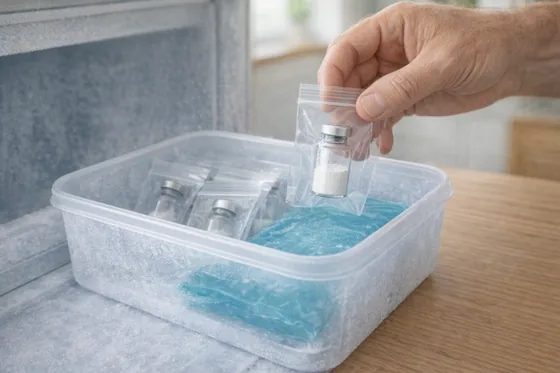
A freezer-safe container can be practical, with each vial individually and airtight packed. A cold pack can buffer short temperature swings a little when you take something out, but it is not mandatory and does not replace a stable freezer temperature.
If you use a cold pack, it should also sit inside a sealed zip-lock bag. This lowers the risk that damage or condensation adds extra moisture to the box. A piece of kitchen towel and additional silica-gel sachets in the box can help catch moisture in the outer packaging.
For especially sensitive or very long-term laboratory storage, oxygen can also matter. In professional settings, oxidation-sensitive peptides are sometimes stored tightly sealed under an inert gas such as nitrogen or argon. For you, the key point is: this is a technical best-practice note, not a blanket requirement for every peptide.
Avoid frost-free and auto-defrost freezers
Frost-free freezers or freezer compartments with automatic defrost cycles can be unfavorable for sensitive long-term storage. They often work with temperature changes to prevent ice build-up.
That is convenient for food, but it can be a problem for sensitive peptides. Repeated temperature swings increase the risk of condensation, moisture entry and loss of stability. If long-term storage is necessary, a freezer with the most stable temperature possible is usually the better choice.
Put freeze-thaw cycles into context
For reconstituted solutions, repeated freezing and thawing is especially critical. For dry, fully sealed lyophilisate, a single temperature change does not automatically mean certain damage. The main concerns are temperature swings, condensation and moisture uptake.
As a precaution, it still makes sense not to keep taking the vial out. Open the box only briefly, remove the bag you need and put the box back. This helps the remaining vials stay as cold and dry as possible.
Do not casually portion peptide powder at home. Transferring lyophilisate can increase contamination, moisture entry, substance loss and measurement errors. Done properly, this requires a suitable sterile or aseptic environment, for example a lab clean bench, with appropriate containers and clear procedures.
What to watch when taking it out?
Let the frozen vial come to room temperature before opening it. As a rough rule of thumb, about 15-20 minutes may be enough, depending on vial size, packaging and room temperature. If you open it while it is too cold, condensation can form.
This condensation is a problem for hygroscopic powder because the lyophilisate can absorb that moisture. Let it warm up first, then open it and - if appropriate - follow a suitable guide to reconstitute peptides.
Common questions about shelf life, refrigeration and handling are answered in the Peptigraph FAQ. I keep the safety rules on Peptigraph deliberately cautious because peptides can differ a lot in stability.
Note: This information is not medical advice and not a dosing, use or sourcing recommendation. Many substances are experimental and are not approved for human use.
Not medical advice.
Step by step
-
 Step 1
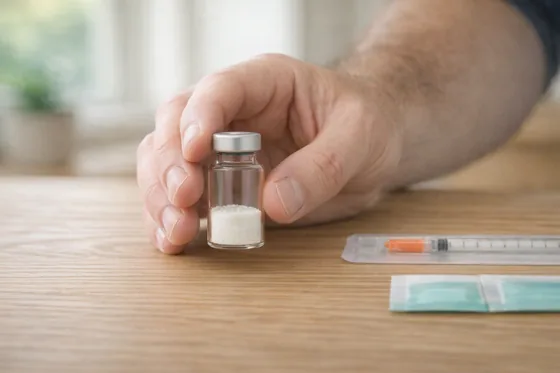
Freeze dry powder only
As a general safety rule, only dry powder belongs in the freezer, meaning the lyophilisate. A mixed, reconstituted peptide solution should not be frozen unless the manufacturer or laboratory instructions explicitly say so.
For solutions, freezing can promote aggregation, precipitation, pH and concentration shifts, and risks during thawing. That is more practically relevant than the simplified idea that ice crystals always directly tear peptide chains apart.
-
 Step 2
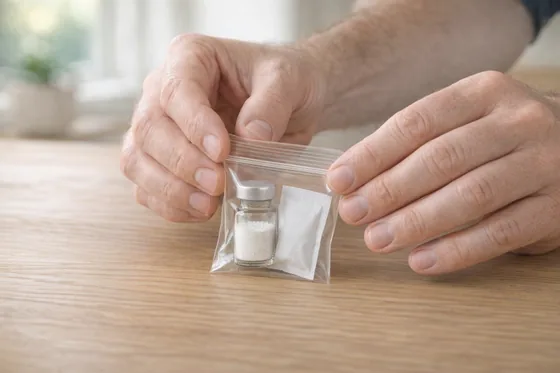
Protect it airtight with desiccant
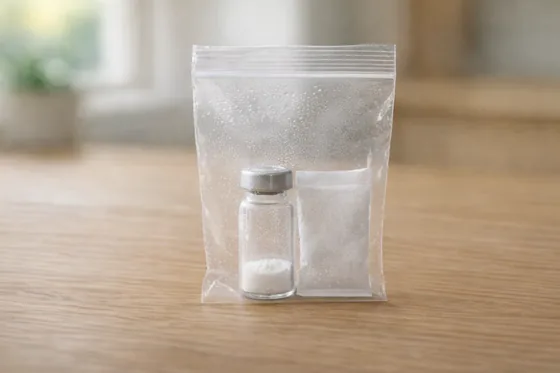
Each sealed vial goes into its own zip bag, together with one desiccant sachet, usually sold as silica gel. Close the zip bag airtight.
This does not protect the inside of the sealed vial - nothing gets in there. It keeps the air in the bag dry, and that matters when you open it and during temperature changes: if moisture condenses there, the hygroscopic powder can absorb it as soon as you open the vial.
When buying desiccant you can usually choose the sachet size. For a single vial in a zip bag, very small sachets of about 1 g work well. The large sachets from electronics or shoe packaging are unnecessarily bulky for this.
For oxidation-sensitive peptides, oxygen can also play a role. In laboratory or manufacturer settings, inert gas such as nitrogen or argon is sometimes used for very long-term storage. Whether that makes sense depends on the specific peptide and its stability data.
-
 Step 3
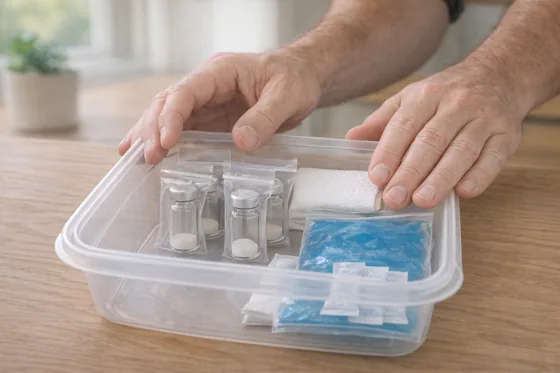
Pack it into a freezer-safe box
Put the airtight packed vials into a freezer-safe container. Try to keep the vials upright and make sure each vial is individually protected.
A cold pack can buffer short temperature swings a little when you take something out, but it is not a required standard. If you use one, also place the cold pack in a sealed zip-lock bag so it does not spread extra moisture if condensation forms or if it gets damaged.
A piece of kitchen towel and 2-3 silica-gel sachets in the box can help catch moisture in the outer packaging. The benefit depends on the box, packaging and temperature stability.
-
 Step 4
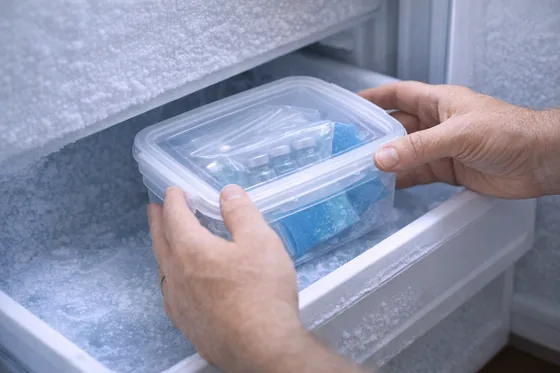
Store at -18 °C to -20 °C or colder
As a rule of thumb, dry peptide powder is often stored at about -18 °C to -20 °C or colder. How long it stays stable depends strongly on the peptide, purity, residual moisture, packaging, light, oxygen and the actual temperature stability.
In the frozen, dry state the powder has set like glass: the molecules are practically immobile, free water is missing, and the known degradation routes run orders of magnitude slower than in solution. The common figure of one to two years is therefore a cautious manufacturer statement rather than a chemical limit. Under good conditions, five years and more is plausible; under poor ones, clearly less than two.
Which of the two applies is decided by four things: how dry the powder was filled, whether oxygen sits in the vial, how constant the temperature stays, and which amino acids the sequence contains. The manufacturer decides the first two, and they appear on no COA. You decide the last two.
In detail, with sources and the limits of the claim: How long do frozen peptides really last?
Frost-free or auto-defrost freezer compartments are unfavorable for sensitive long-term storage because automatic defrost cycles can cause temperature swings.
-
 Step 5
Avoid temperature swings and condensation
Avoid taking vials in and out repeatedly. For dry, unopened lyophilisate, a single temperature change is not always clearly harmful, but temperature swings, condensation and moisture uptake can affect stability.
When you need a vial, take the box out only briefly, remove one bag and put the box straight back. A cold pack can soften short swings a little, but it should not be treated as a replacement for stable storage conditions.
Portioning powder or transferring it into other vials is problematic outside suitable laboratory conditions. Done properly, this only belongs under sterile or aseptic conditions, for example at a laminar-flow clean bench, with suitable containers and clear procedures.
-
 Step 6
Warm up before opening
Let the frozen vial come to room temperature before opening it. As a rough rule of thumb, about 15-20 minutes may fit, depending on vial size, packaging and room temperature.
Two stages are gentler still: put the unopened vial in the fridge first, then let it come to room temperature. The smaller the temperature jump, the less condenses.
Gentlest of all, the vial stays inside the closed zip bag while it warms up. Condensation then forms on the outside of the bag instead of on the powder. Only open the bag once it has reached room temperature.
If you open it while it is too cold, condensation can form. The hygroscopic powder can absorb this moisture, which may affect stability.
Pass this guide on as an image

