Peptigraph › Guides › How to reconstitute (mix) peptides: step by step
Guide
How to reconstitute (mix) peptides: step by step
How to dissolve the powder safely with BAC water into an injectable solution - clean, without shaking and with the right amount of water.
Reconstituting or mixing peptides means dissolving a freeze-dried powder, the lyophilisate, with a suitable sterile diluent. That does not automatically make a peptide safe to inject. Safety can depend on pharmaceutical quality, sterility, endotoxin testing, approved use, diluent, storage and aseptic handling.
This Peptigraph guide is educational information only. It is not medical advice, a dosing recommendation or a sourcing recommendation. Only sterile medicines approved for injection, or physician-prescribed products, should be reconstituted according to the prescribing information or package leaflet. Research-grade peptides and many peptides sold online are often not intended for human use.
What does mixing or reconstituting mean?
'Mixing' and the technical term 'reconstitution' mean the same step: the powder becomes a liquid again. Think of it like instant powder: only the right diluent and the right concentration turn it into a defined solution, not automatically into a safe medicine.
The amount of diluent you add changes the concentration, meaning how much active ingredient is contained per millilitre. From that, you can calculate how many IU, meaning insulin units on a U100 syringe, correspond to a calculated amount. The peptide injection calculator can help with that conversion, but it does not replace prescribing information, medical instructions or laboratory data.
What do you need for reconstitution?
- A peptide vial with powder, ideally an approved or physician-prescribed product with clear prescribing information.
- A suitable sterile diluent according to the manufacturer. BAC water, meaning bacteriostatic water with benzyl alcohol, is common, but it is not universally suitable.
- No tap water. Sterile saline, PBS or other buffers may be intended for some peptides, but they should not be swapped in casually.
- Sterile syringes and needles as single-use material. For small volumes, a U100 insulin syringe can be practical. For larger reconstitution volumes, a separate sterile 2-3-ml mixing syringe with Luer-lock and a suitable needle can be useful.
- Alcohol swabs, a disinfected work surface and optional nitrile gloves.
- A puncture-resistant sharps container for needles and syringes.
Common beginner questions about BAC water, concentration and units are covered in the peptide FAQ. For a broader overview of compounds and context, see the peptide overview.
BAC water, sterile water or another diluent?
BAC water is sterile water with benzyl alcohol. The additive can inhibit microbial growth and may allow multiple withdrawals from a multi-dose container. It does not guarantee that a reconstituted peptide solution stays chemically stable or microbiologically safe for weeks.
Sterile water without a preservative is often intended more for single use. Some medicines or peptides may need other diluents, such as sterile sodium chloride solution, a buffer or an acidic solution. The prescribing information, package leaflet, manufacturer instructions and, for laboratory products, at least reliable information on sterility, endotoxins and stability are what matter.
BAC water is not suitable for every person or every peptide. Benzyl alcohol can be poorly tolerated and is especially problematic in newborns. During pregnancy, with allergies, existing medical conditions or prescribed medicines, product information and medical advice should take priority.
How long do BAC water and the finished solution last?
For opened multi-dose containers, a beyond-use date of about 28 days is often mentioned as a rule of thumb, unless the manufacturer specifies something else. The main reason is the contamination risk from repeated withdrawals, not necessarily a clearly proven loss of benzyl alcohol effect. BAC water should be stored according to the manufacturer; many products are stored at controlled room temperature, but instructions can differ.
For reconstituted peptide solutions, there is no universal 21-30-day rule. Stability can depend on the peptide, concentration, pH, diluent, light, temperature, sterility and actual handling. 2-8 °C and protection from light are common rules of thumb, but the specific prescribing information or manufacturer instruction comes first.
When should you discard it?
Discard material if you have any doubt about sterility, an expired date, unclear storage, a damaged or leaking vial, cracks, a damaged stopper or a touched needle. BAC water does not make a contaminated solution safe again. If sterile parts are touched accidentally, new single-use material should be used.
The finished solution should be checked before every withdrawal for cloudiness, particles, flocculation, discoloration and unusual changes. Small air bubbles are not the same as contamination, but they should be allowed to settle before withdrawal. If the solution remains cloudy, discoloured or contains particles, it should not be used.
When logged in, you can document mixing date, amount, diluent and usage with the Injection Manager. That is especially helpful if several vials or different dilutions are involved.
Not medical advice.
Step by step
-
 Step 1
Prepare cleanly and aseptically
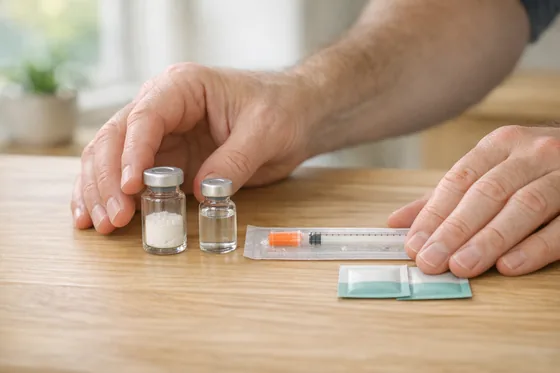
Wash your hands, disinfect the work surface and lay everything out calmly: peptide vial with powder, suitable sterile diluent, sterile syringes and needles, alcohol swabs, label and a puncture-resistant sharps container.
Optional nitrile gloves can help you work cleanly. The most important point is this: do not touch sterile needles, syringe interiors or stoppers after disinfection. If you touch a sterile tip or suspect contamination, discard that item and use new single-use material.
If the peptide vial comes straight from the fridge or freezer, let it come to room temperature first - just let it sit for a bit. The powder dissolves more easily afterwards.
-
 Step 2
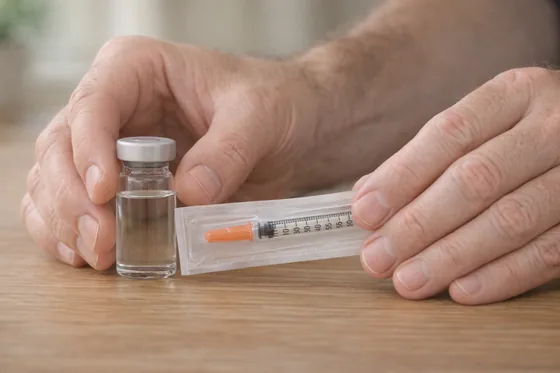
Check diluent and water amount
First check which diluent is intended according to the prescribing information, manufacturer instructions or reliable product information. BAC water is a common case, but some peptides can require sterile saline, PBS, acidic buffers or other conditions.
The added volume determines the concentration. The injection calculator can show the conversion between total amount, volume and IU on the syringe, but it is not a dosing or use recommendation.
-
 Step 3
Disinfect the stoppers
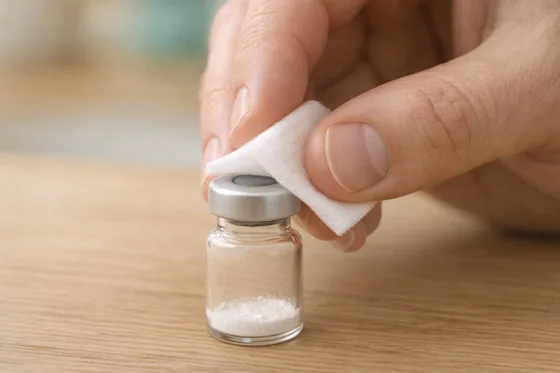
On a new vial, first flip off the coloured cap of the metal seal. The metal ring stays on the vial; you disinfect only the exposed rubber stopper.
Wipe the rubber stoppers of the powder vial and diluent vial with an alcohol swab. Let them dry briefly before puncturing. Wet alcohol residue can interfere, and touching the stopper after disinfection can introduce microbes again.
-
 Step 4
Draw up the sterile diluent
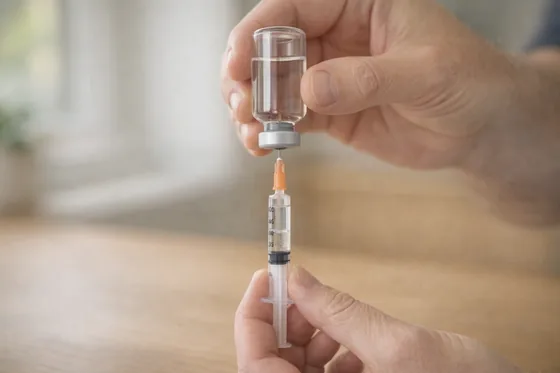
Draw the calculated amount of the suitable sterile diluent into a sterile syringe. For small volumes, a U100 insulin syringe can be practical. For more than 1 ml, a separate sterile 2-3-ml mixing syringe with Luer-lock and a suitable needle can make the process easier.
With multi-dose vials, it can help to first draw the same amount of air into the syringe and inject it into the diluent vial before withdrawing liquid. This can equalise pressure and prevent withdrawal from becoming harder each time.
Syringes and needles are single-use material. A needle or syringe used for mixing should not be reused later for an injection.
-
 Step 5
Puncture the peptide vial in a controlled way
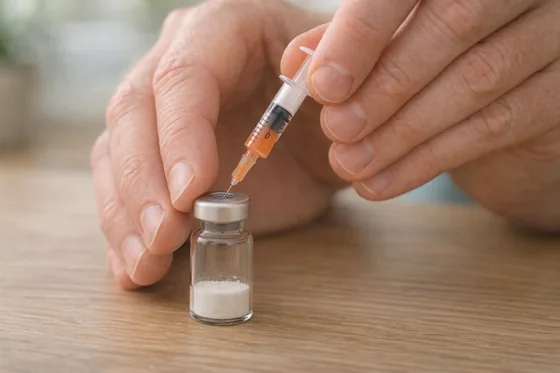
Puncture the peptide vial with the filled syringe through the centre of the rubber stopper, then angle the needle toward the glass wall. Keep the plunger controlled while you do this.
The vial is usually under negative pressure. If you don't hold the plunger, water can drip straight from the syringe onto the powder. We want to avoid that. Don't worry: if it happens once, the peptide isn't ruined - what matters is that you end up with a completely clear solution, with no leftover powder and no foam.
-
 Step 6
Let it run down the glass wall
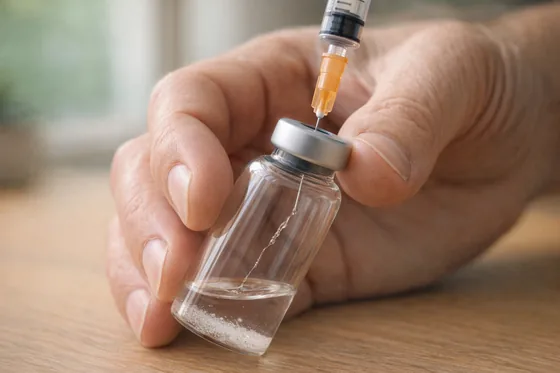
Place the needle at an angle against the inner wall of the powder vial and let the diluent slowly run down the glass wall. This wets the powder more gently and is more likely to avoid strong foaming.
Do not spray with pressure directly onto the powder. Especially with sensitive peptides, calm handling is like pouring along the side of a glass: less jet, less foam, less mechanical stress.
-
 Step 7
Dissolve gently, do not shake
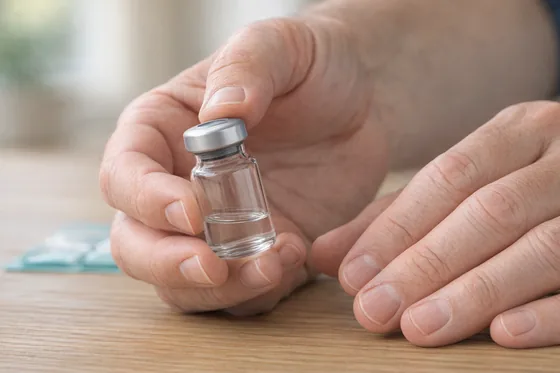
Gently roll or swirl the vial between your fingers until the powder has dissolved. Shaking is unfavourable because strong shear forces and foam can stress sensitive peptide chains.
If fine bubbles or some foam appear, place the vial down calmly, for example refrigerated if the product information allows it. As a rule of thumb, as little as 5-20 minutes of rest can help, but this depends on the peptide and diluent.
Check the solution for cloudiness, particles, flocculation and discoloration. Small air bubbles are not automatically a sign of contamination. If the solution remains cloudy, contains particles or changes colour, it should be discarded.
-
 Step 8
Label, store appropriately and do not generalise shelf life
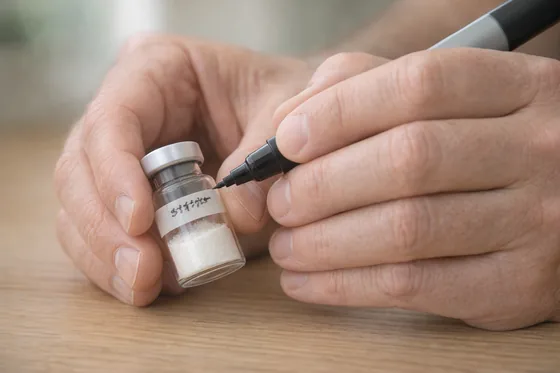
Clearly label the vial with peptide name, total amount, added volume, concentration, diluent, reconstitution date and planned discard date. Just writing '10 mg' is not enough if several vials or different dilutions exist.
Store according to the prescribing information, package leaflet or manufacturer instructions. For reconstituted peptide solutions, 2-8 °C and protection from light are common rules of thumb, but shelf life and temperature handling depend on the specific peptide, diluent, pH, manufacturer and CoA, meaning certificate of analysis. A blanket 21-30-day rule is only a rough rule of thumb and can be too long or too short.
When logged in, you can record the date, amount, diluent, concentration and use of each mix in the Injection Manager. That helps avoid mix-ups.
Many peptides are cautiously stored dark, cool and protected from moisture when better data are not available. Opaque insulin or medication cooler cases are practical and discreet; they are surprisingly cheap on online marketplaces, for example a search for "vial case" on AliExpress.
-
Step 9
Dispose of single-use material and discard if in doubt
Dispose of used needles and syringes immediately in a sharps container or another suitable puncture-resistant container. Do not leave used needles loose on the table, and do not recap needles unnecessarily because that can increase the risk of needle-stick injury.
Discard the vial or material if the stopper is damaged, there are cracks or leaks, the material is expired, storage is unclear, a sterile needle was touched, or you see particles, discoloration, flocculation, persistent cloudiness or any doubt about sterility. BAC water can inhibit contamination, but it cannot reliably reverse it.
Pass this guide on as an image


Sources
- Bacteriostatic Water for Injection, USP - FDA prescribing information (DailyMed, NIH)
- Hoofnagle AN et al. Recommendations for the generation, quantification, storage and handling of peptides. Clin Chem 2016. PMC4830481
- Care and Handling of Peptides - Bachem technical note
- Handling and Storage Guidelines for Peptides - Bachem