Peptigraph › Guides › Calculating a peptide dose and reading it on the syringe
Guide
Calculating a peptide dose and reading it on the syringe
From mg in the vial to the right number of units (ticks) on an insulin syringe - how to work out the dose cleanly and read it correctly.
The total amount of a peptide is in the vial, but the concentration of the finished solution determines what volume you would need to draw up for a given active amount. For that, you need three things: active amount, final solution volume and the correct scale on your syringe. The Injection Calculator can make the calculation easier to follow, but it cannot replace product information or a medical decision.
This guide only explains calculation and syringe-reading mechanics for peptides. It is not a dosing recommendation, not an application recommendation and not medical advice.
Concentration: milligrams per milliliter
The key value is the concentration in milligrams per milliliter (mg/ml). In simple terms: you want to know how much active substance is in one milliliter of the finished solution. From that, you can calculate what volume would correspond to a given active amount.
In practice, people often calculate approximately: active amount in the vial divided by the amount of diluent added. Strictly speaking, however, concentration means active amount per final volume of the finished solution. Powder and excipients can displace a small amount of volume, which can matter for very precise pharmaceutical specifications.
As pure calculation logic, for example: 5 mg peptide in about 2 ml of finished solution gives about 2.5 mg/ml. If less diluent is used for the same active amount, the concentration can be higher and the volume to draw up would be smaller. How reconstitution, meaning dissolving a lyophilisate, can be assessed more safely is covered in the guide to reconstituting peptides.
Use only sterile diluents that are suitable for the specific product according to manufacturer, pharmacy or professional information. BAC water, meaning bacteriostatic water, is not automatically suitable for every substance, every person or every situation because it contains benzyl alcohol.
U-100 units are a volume scale
On a U-100 insulin syringe, the scale means: 100 units correspond to 1 ml. In this context, the units are volume markings on the syringe. Do not confuse that with biological International Units (IU) of an active substance, because that is a different concept.
Also important: not every visible line automatically equals 1 unit. On 0.3-ml and 0.5-ml U-100 syringes, small lines often mark 1 unit. On 1-ml U-100 syringes, small lines often mark 2 units. Always check the exact syringe size and scale before transferring any calculation to the markings.
The target amount and the concentration first give a volume in ml. That volume is then converted into U-100 units. You can find more simple examples of the logic in the Peptigraph FAQ.
With very small target volumes, even half a line can be relatively important. A more finely scaled syringe or a different concentration can be mathematically more sensible. Whether that is possible and suitable for a specific peptide depends on the product, solubility, stability and professional information.
Read correctly: plunger edge, not liquid level
A syringe is read at the relevant edge of the black plunger stopper, not at the liquid surface. This usually means the plunger edge facing the liquid or needle, unless the syringe manufacturer shows something different. The liquid meniscus, meaning the slightly curved surface of the solution, is not a clean reference for this.
Air bubbles should not be "compensated" for by reading at the liquid level. If air sits between the plunger and the liquid, the actual liquid volume can be smaller than you think. Remove bubbles carefully and then read again at the correct plunger edge.
Cloudy, discolored peptide solutions or solutions with visible particles should not be used. A finished solution should be clear before withdrawal, unless the product information describes something else.
Let the calculator calculate, but check the limits
The Injection Calculator can translate vial size, assumed diluent amount, syringe type and target amount into concentration, volume and U-100 units. That can reduce arithmetic errors, especially when mg, mcg, ml and units get mixed up.
A calculator cannot know whether a specific water amount is suitable for this exact product. That depends, among other things, on solubility, stability, vial capacity, syringe resolution, desired volume range, injection tolerability and manufacturer or pharmacy information.
For adding diluent to the vial, some aseptic workflows may use a separate suitable syringe so the thin U-100 needle is not stressed unnecessarily. For pressure equalization, many instructions describe adding about the same amount of air to the vial before adding the diluent. Sterile technique and the requirements for the specific product remain decisive.
Document it instead of memorizing it
When logged in, you can use the Injection Manager to record, per vial, what concentration is calculated, which syringe was used and which scale value corresponds to which calculated amount. This can help avoid mix-ups between similar-looking vials or different reconstitutions.
Shelf life and storage must not be derived from a calculator as a blanket rule. They depend on the peptide, manufacturer information, CoA, the certificate of analysis, sterility, diluent, storage, contamination and withdrawal frequency. A documented use-by window is therefore only as good as the source behind it.
Peptigraph is an independent knowledge project by Samuel. My goal is to make calculation paths and risks understandable, not to recommend doses, sources or applications. Many peptides are experimental or not approved for human use.
Not medical advice.
Step by step
-
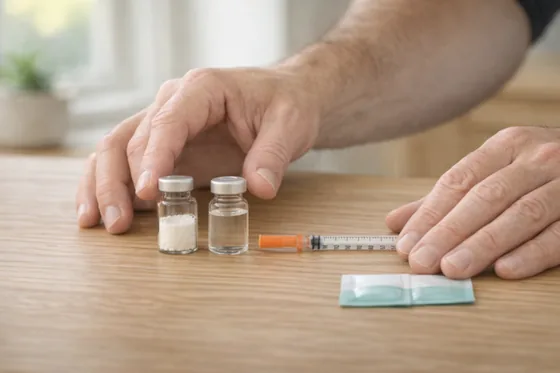 Step 1
Understand concentration correctly
The total amount of active substance is in the vial. The concentration of the finished solution determines what volume would correspond to a given active amount.
In practice, people often calculate with active amount divided by added diluent. Strictly speaking, however, the final volume of the finished solution counts, because powder and excipients can displace a small amount of volume.
Use only sterile, suitable diluents according to manufacturer, pharmacy or professional information. BAC water is not universally suitable because it contains benzyl alcohol.
-
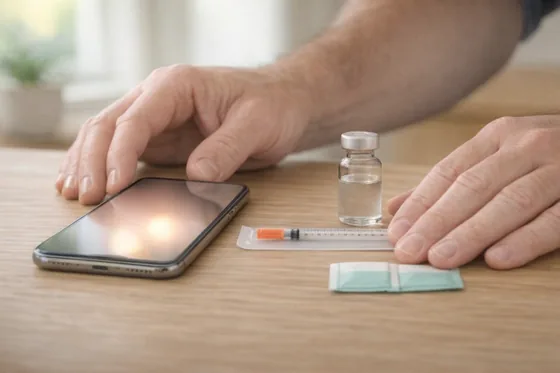 Step 2
Assess the water amount as a calculation only
Enter vial size, assumed diluent amount, syringe type and target amount into the Injection Calculator. It can calculate concentration, volume and U-100 units from those inputs.
Less diluent can mean a higher concentration and therefore a smaller volume. Whether a water amount is actually suitable depends on solubility, stability, vial capacity, syringe resolution and product information.
-
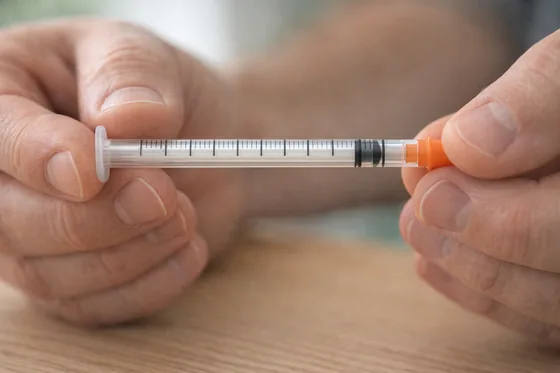 Step 3
Do not confuse U-100 units with syringe lines
On a U-100 insulin syringe, the volume scale means: 100 units = 1 ml. These units are syringe markings and not automatically biological International Units (IU) of an active substance.
Not every line is 1 unit. On 0.3-ml and 0.5-ml U-100 syringes, small lines often equal 1 unit. On 1-ml U-100 syringes, small lines often equal 2 units. Always check the exact scale of your syringe.
-
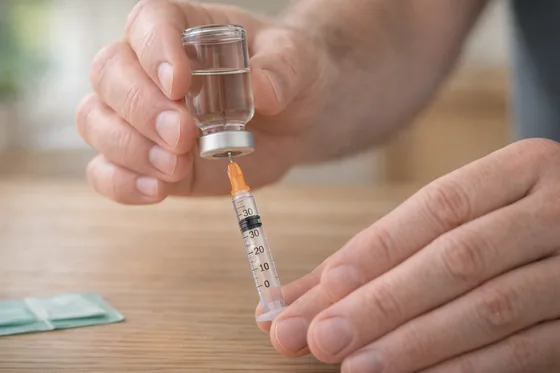 Step 4
Check clarity, remove bubbles, read at the plunger
Before drawing up, check whether the peptide solution is clear. Cloudy, discolored or particle-containing solutions should not be used, unless the product information describes something else.
Draw the solution up calmly and remove air bubbles carefully. Then read at the relevant edge of the black plunger stopper, not at the liquid level. The liquid meniscus is not a clean reference for the dose.
Air bubbles are not corrected by reading at the liquid surface. If bubbles were present, remove them and then check the scale value again at the plunger edge.
-
 Step 5
Document it with the Injection Manager
Record concentration, syringe type, scale value and use per vial so you do not calculate from memory. Especially with similar-looking vials, documentation can reduce mix-ups.
When logged in, you can use the Injection Manager for this. Mix date, amount and use are then kept in one place.
Shelf life and storage depend on the peptide, manufacturer, CoA, sterility, diluent and storage conditions. A use-by window is therefore only a rule of thumb if no reliable product information is available.